
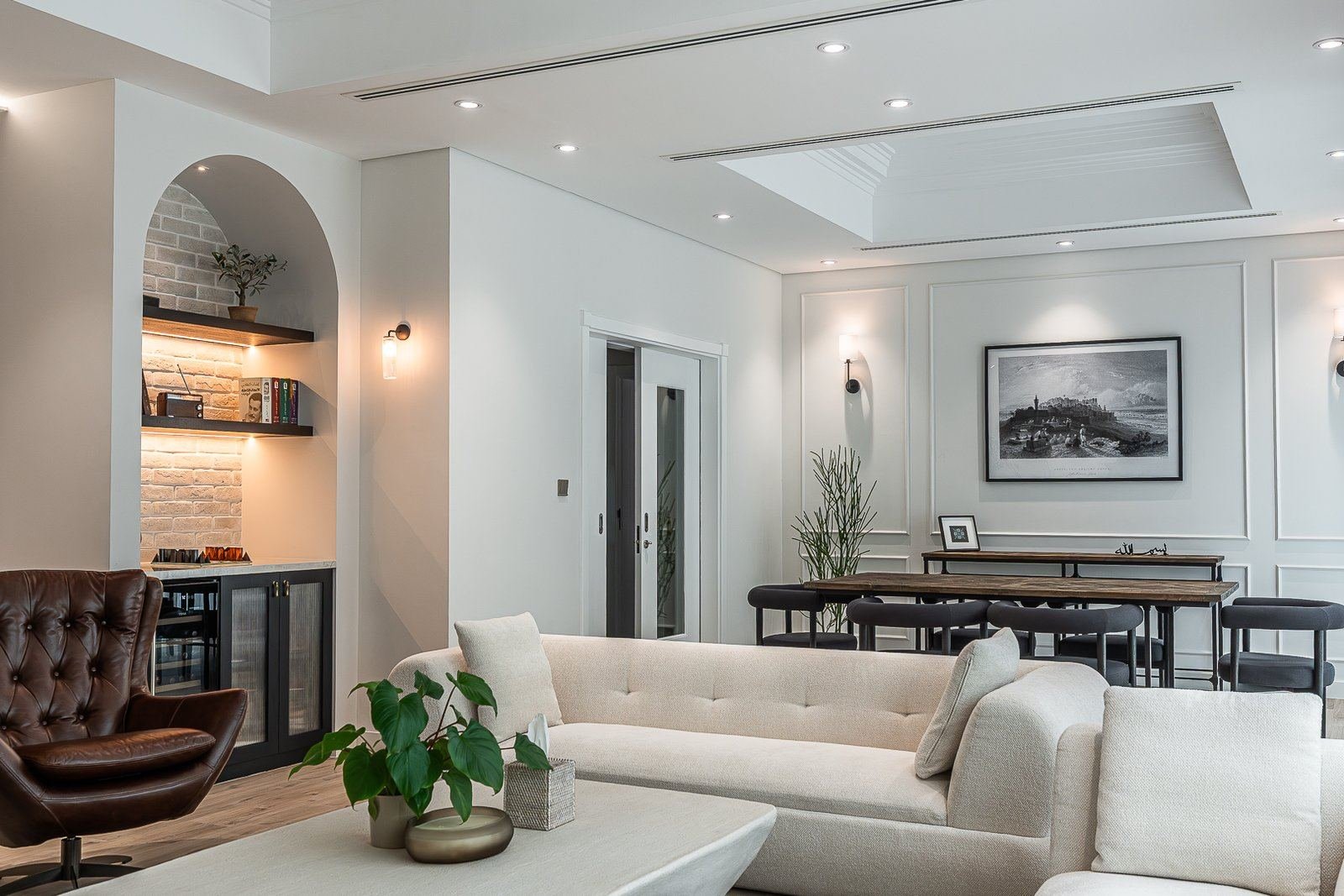
Get the room right before the style
Most majlis design ideas you find online are about style: Arabic, modern, Moroccan, minimal. Style matters, but a majlis fails for other reasons. Guests walk through the family’s living area to reach it. Someone always has their back to the door. Coffee arrives through the middle of the room. The seating holds the number in the render, not the number who come at Eid. Every one of those is a planning decision, and none of them can be fixed with cushions later.
So the first set of ideas below is about the room itself. The second set is about the look, for both modern and Arabic majlis interiors.
Layout ideas that make a majlis work
Give guests their own way in
The best majlis has its own entrance from outside, or at least a route from the front door that does not cross family space. A guest washroom close by completes it. In an existing villa this can mean a new external door or opening two rooms into one, which usually needs the developer’s approval, so it belongs at the start of the design.
Seat everyone facing in
The traditional arrangement is seating along the walls in a U or a full square, so everyone can see everyone and the host can see the door. Avoid islands of sofas in the middle of the room that put guests' backs to one another.
Plan the service route
Coffee, dates and food need to reach the room from the kitchen or a pantry without passing through the seating. A small serving pantry beside the majlis, with a sink and space for the coffee pots, makes a big difference on a long evening.
Draw the seating to a real headcount
Start with the number you receive on your biggest regular occasion and draw the seating to it. Then size the room. Floor-level seating holds more people in the same space and suits a traditional reception; sofa-height seating is easier for older guests. Many households mix the two.
Two majlis or one
Some families need separate men’s and women’s majlis. That means two rooms, two entrances, a washroom for each and a service route that reaches both without crossing either. It is a different plan from a single majlis, so decide it early.
Ceilings, lighting and air
- Make the ceiling the feature. A coffered, domed or stepped gypsum ceiling gives the room presence without filling the walls. It also hides the cove lighting and the air conditioning.
- Light faces, not just the floor. An indirect cove or wash lights faces evenly. A chandelier or pendant marks the centre of the room. Low lamps or wall lights carry the late evening. Put each layer on its own circuit.
- Plan air movement. A full majlis gets warm, and incense such as bakhoor and oud is part of many evenings. Supply and return grilles should be placed so air moves across the seating without blowing directly onto guests.
- Think about sound. Hard stone floors and bare walls make a full room loud. Rugs, upholstered panels and fabric help conversation carry without echo.
Arabic majlis interior design ideas
An Arabic majlis interior design draws on a long tradition of hospitality, and a few elements carry it:
- Floor-level seating with firm cushions and armrests, made to the wall lengths so the seating runs unbroken around the room.
- Arches and niches in the walls, often framing a feature panel or lighting.
- Mashrabiya screens, the carved or latticed timber screens of Arabic architecture, used for windows, doors or a divider between the majlis and the entrance.
- Pattern in panelling and ceilings, from geometric motifs to carved timber.
- Textiles, including Al Sadu-inspired weaves in deep reds, blacks and creams, used on cushions, rugs or panels.
- Brass and warm metal details in lighting and fittings.
The risk with a traditional room is doing too much. Choose one or two elements to lead, such as the ceiling and the seating fabric, and keep the rest calm.
Modern majlis interior design ideas
A modern majlis interior design keeps the traditional plan and the hospitality, and changes the language:
- Sofa-height built-in seating with clean upholstered backs, sometimes with a low floor-seating section for older relatives who prefer it.
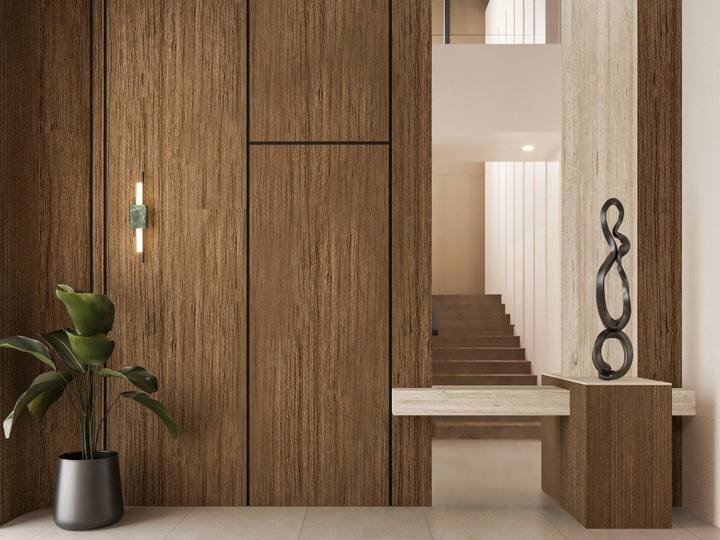
- Flush wall panelling in timber or fabric, with shadow gaps rather than mouldings.
- Stone as a feature, for example a single stone wall behind the main seating or a stone-clad entrance.
- Concealed light: coves, backlit panels and linear light in place of large chandeliers.
- A restrained palette of sand, stone, warm grey and timber, with colour brought in through cushions and rugs that can change.
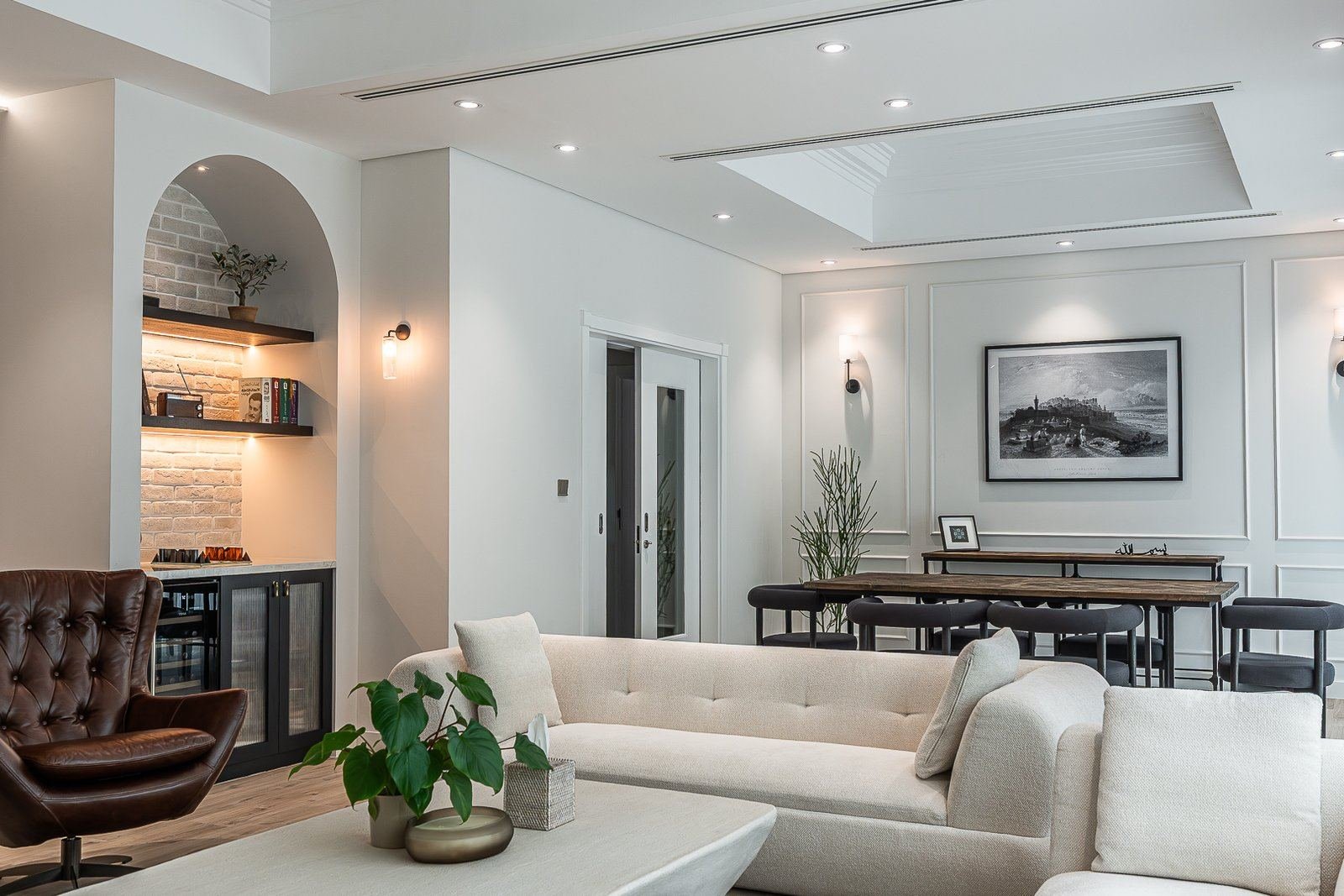
Many of our clients choose something in between, often called modern Arabic: the traditional U-shaped seating, an arch or a mashrabiya motif, and a lighter palette with concealed lighting. It ages well because the plan is traditional and the finishes are calm.
Made, not bought
A majlis is one of the few rooms where almost everything is custom. The seating has to fit the walls exactly, the panelling has to line up with the arches and niches, and the ceiling has to carry the lighting. We make the seating, frames and upholstery together in our Al Quoz workshop, and the panelling and ceilings are shop-drawn before they are made. Fabrics and leathers are sampled with you first. For finished villa interiors by our team, see Villa Al Quortaj, with its restrained panelling, and Golf Place.
Take the majlis outside
For many families the outdoor majlis is used more than the indoor one: tea after sunset, late guests, Ramadan nights and the cooler months. An outdoor majlis needs shade that is in the right place in the late afternoon, air moving through it, seating and fabrics made for outdoor use, warm low lighting, and privacy from neighbours. It works best when it is designed with the garden and shares a language with the indoor majlis. See our outdoor majlis service.
A note on approvals
Seating and loose panelling on their own rarely need approval. A new ceiling with new circuits, a new external door, a new washroom or an outdoor structure usually do: the developer NOC and, depending on the work, the permit from the authority that covers your area. We confirm the route at the site visit and prepare the drawings. More on our authority approvals page.
To plan a majlis with the team that will make it, see our majlis interior design service.